Jesper Landberg's WebGL portfolio hangs on curved panels
Jesper Landberg's site is one Three.js room: curved panels of client work on a grid floor, one sentence of copy each. Site of the Day at 7.73.
Awards · The Editors · 4 min read ·
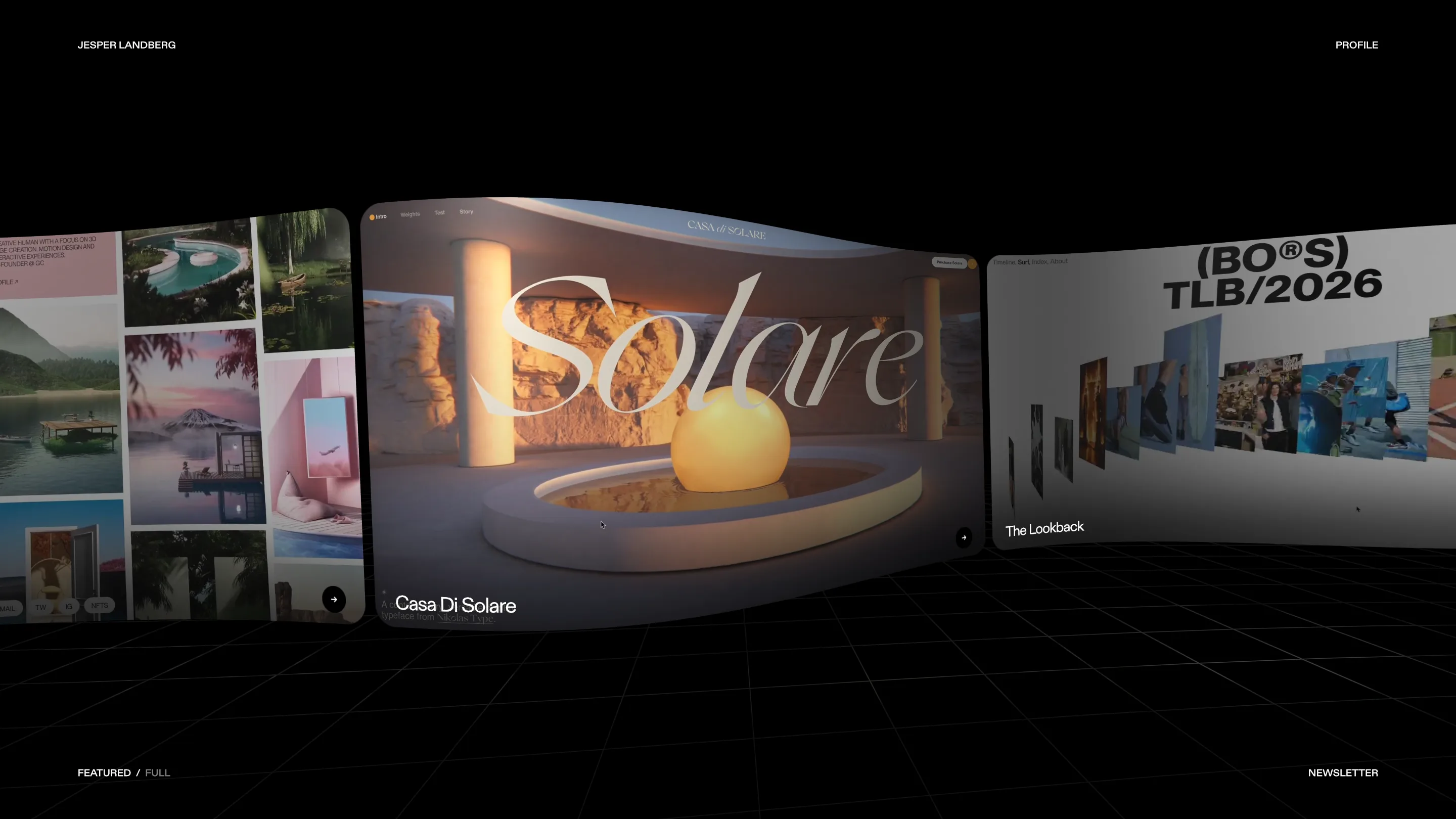
Featured: Jesper Landberg
Jesper Landberg's WebGL portfolio has no pages in the usual sense. The homepage is one Three.js scene: a black room, a grid floor running back to the horizon, and his work hanging on curved panels that slide past as you scroll sideways. Each panel carries a screenshot of a site he built, bent like a shop window so the light catches along the edge. It took awwwards Site of the Day on 29 September 2026 at 7.73, with a Developer Award at 8.17.
A WebGL portfolio with no grid
There are no thumbnails and no cards. The curve is the frame. Three sites sit in view at once, the middle one square to camera and the two flanks turned away, so your eye lands where he wants it without a single highlight state.
The middle panel when I looked was Casa Di Solare, a typeface site whose display italic stays legible wrapped around the bend. To its right, The Lookback, set in a fat grotesk shouting (BO®S) TLB/2026. To its left, Nathan Riley's pink surrealist moodboard. Three different art directions on one stage, none of them fighting, because the room around them is flat black and the only chrome is four words of nav in the corners.
One sentence per project
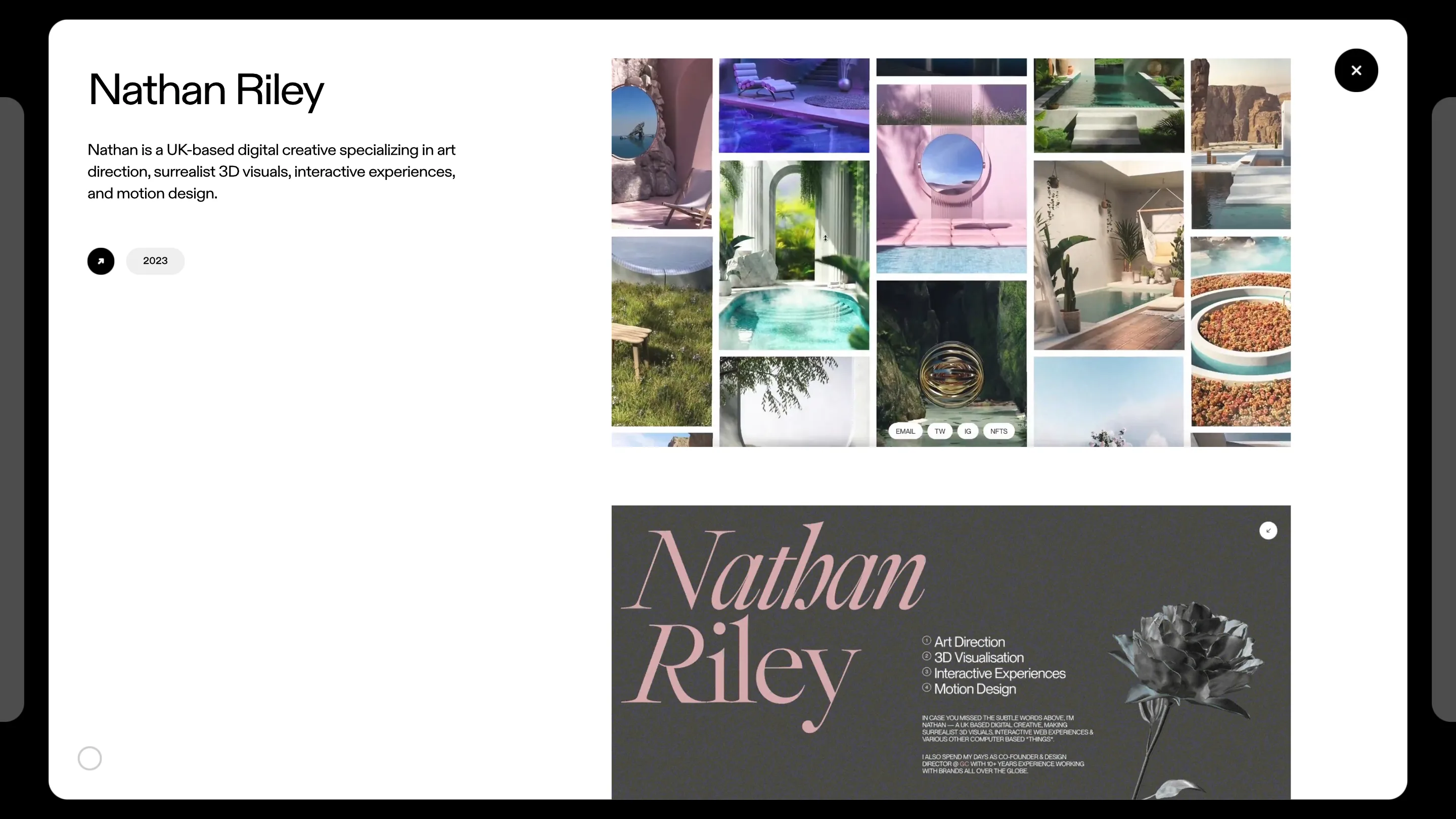
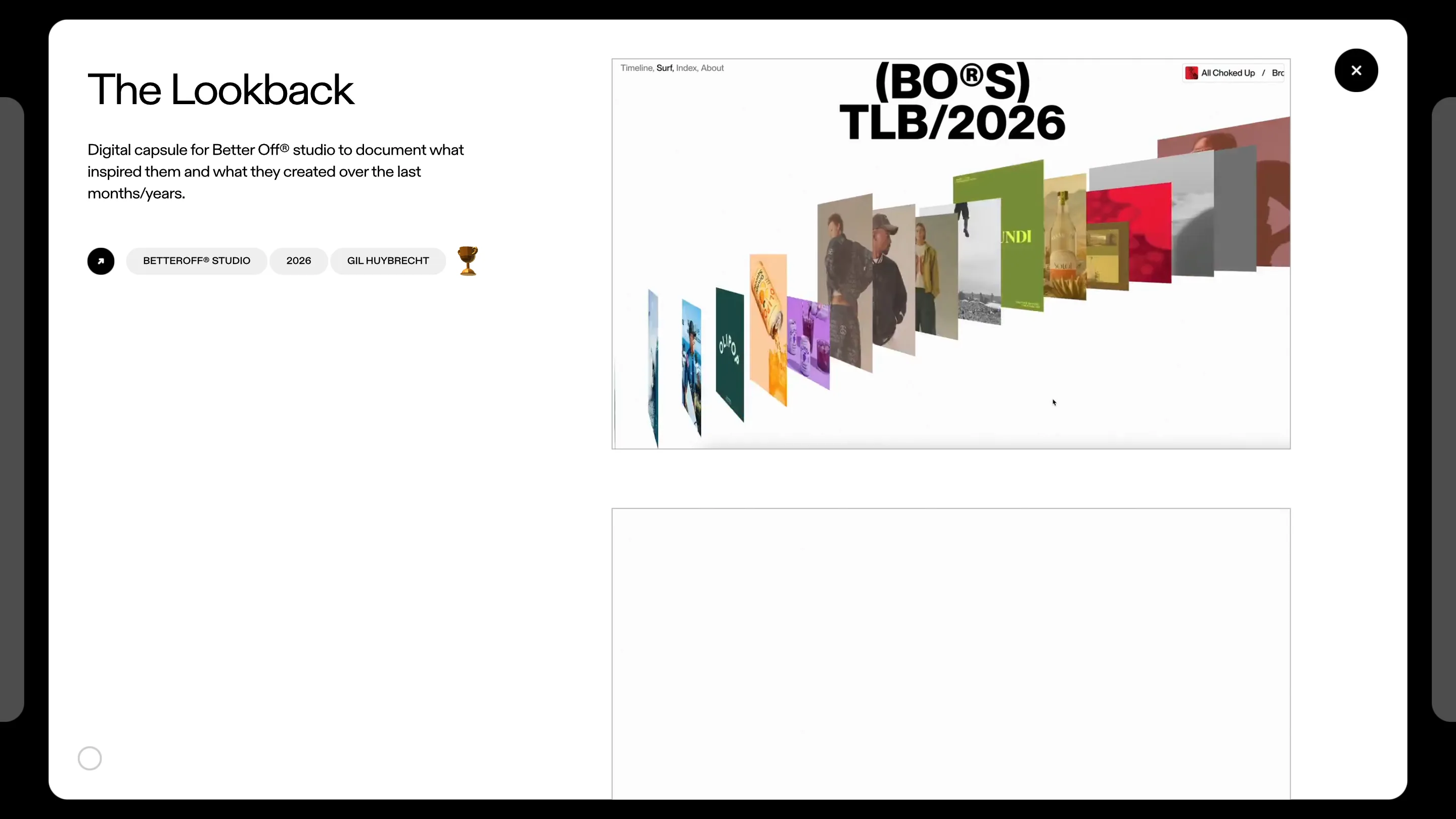
Click a panel and a white sheet rises over the room, rounded at the corners, the stage still visible down both sides. The left column holds the project name, one sentence, and a row of chips: client, year, collaborator, a trophy when it won something. One arrow button goes to the live site. The right column is the work itself, full width, scrolling.
Nathan Riley's entire write-up: "Nathan is a UK-based digital creative specializing in art direction, surrealist 3D visuals, interactive experiences, and motion design." The Lookback gets two lines and three chips. No challenge-approach-outcome, no process reel, no paragraph about discovery. The screenshots make the case and the sentence just says who the client was.
He can afford that. Landberg counts 30 awwwards, 40 FWAs, three Webbys and two Independent of the Year titles, so a screenshot can stand there unexplained.
The index is only type
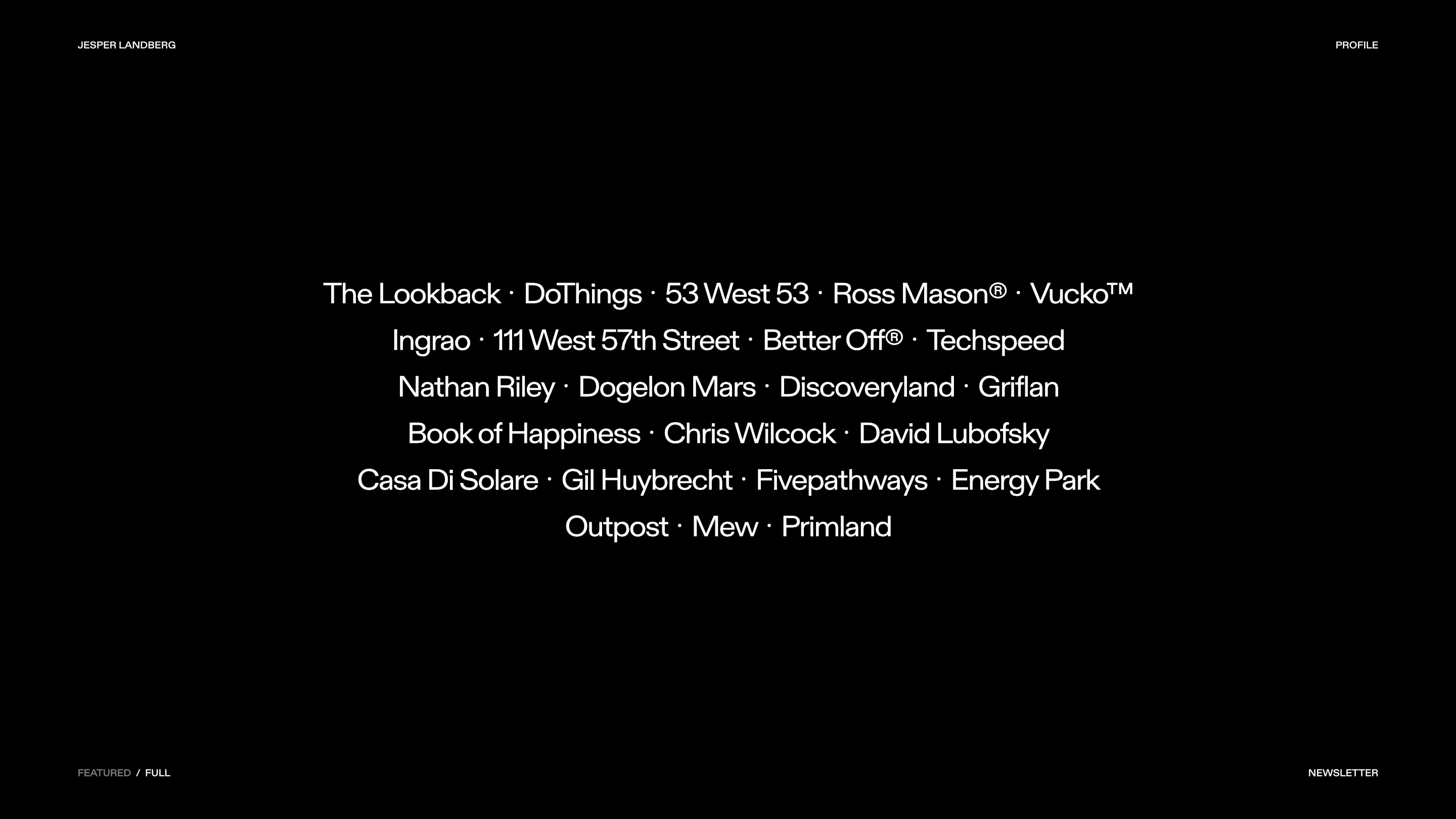
The second nav item, FULL, drops the 3D completely. Twenty-three project names, centred, separated by middots, one grotesk at one size, white on black. No images, no dates, no roles. Someone hunting for 111 West 57th Street or Primland finds it in two seconds.
Two modes, each honest about its job. The carousel is for browsing. The index is for looking something up. Neither one has a filter bar bolted to it.
What the judges rated
The Developer Award at 8.17 came in above the overall 7.73, and that gap is the review. Underneath it is Three.js, GSAP and Nuxt, with infinite scroll on the carousel. The craft sits in making the whole thing behave like one object: the panels hold their bend at every angle, the white project sheet opens over a scene that keeps running behind it, and nothing reloads.
Jesper Landberg works out of Sweden as a design engineer, usually the only developer on a job. His own site states that role plainly. He treated the layout as a rendering problem, built a room, and hung the work on the walls.