Life Stories' oral history website design counts every clip
Life Stories cut 457 interviews into 12,151 timed stories, and Huncwot's site puts both numbers, and every duration, in plain sight.
Life Stories is an oral history website that tells you exactly how much it holds, and how long each piece runs. The Kunhardt Film Foundation relaunched it on September 24, 2026, with a site by Huncwot and Department of Memory. The archive is 457 long interviews, filmed for documentaries over decades, cut into 12,151 short stories. The design's best decision is to show you that cut everywhere.
Most of the material was shot for something else. One King film alone left 37 hours of interviews with 19 people close to him, and only minutes made it to the screen. Life Stories is what happens to the rest. So the whole interface is built around one idea: a long conversation, sliced into pieces you can watch in two minutes.
Two numbers as a page title
The Stories index opens on one huge word in GT Era Display, set tight and heavy. A red pill hangs off its shoulder: 12151. Right next to it, in a grey so pale it almost disappears, sits the word Interviews with its own pill: 457.
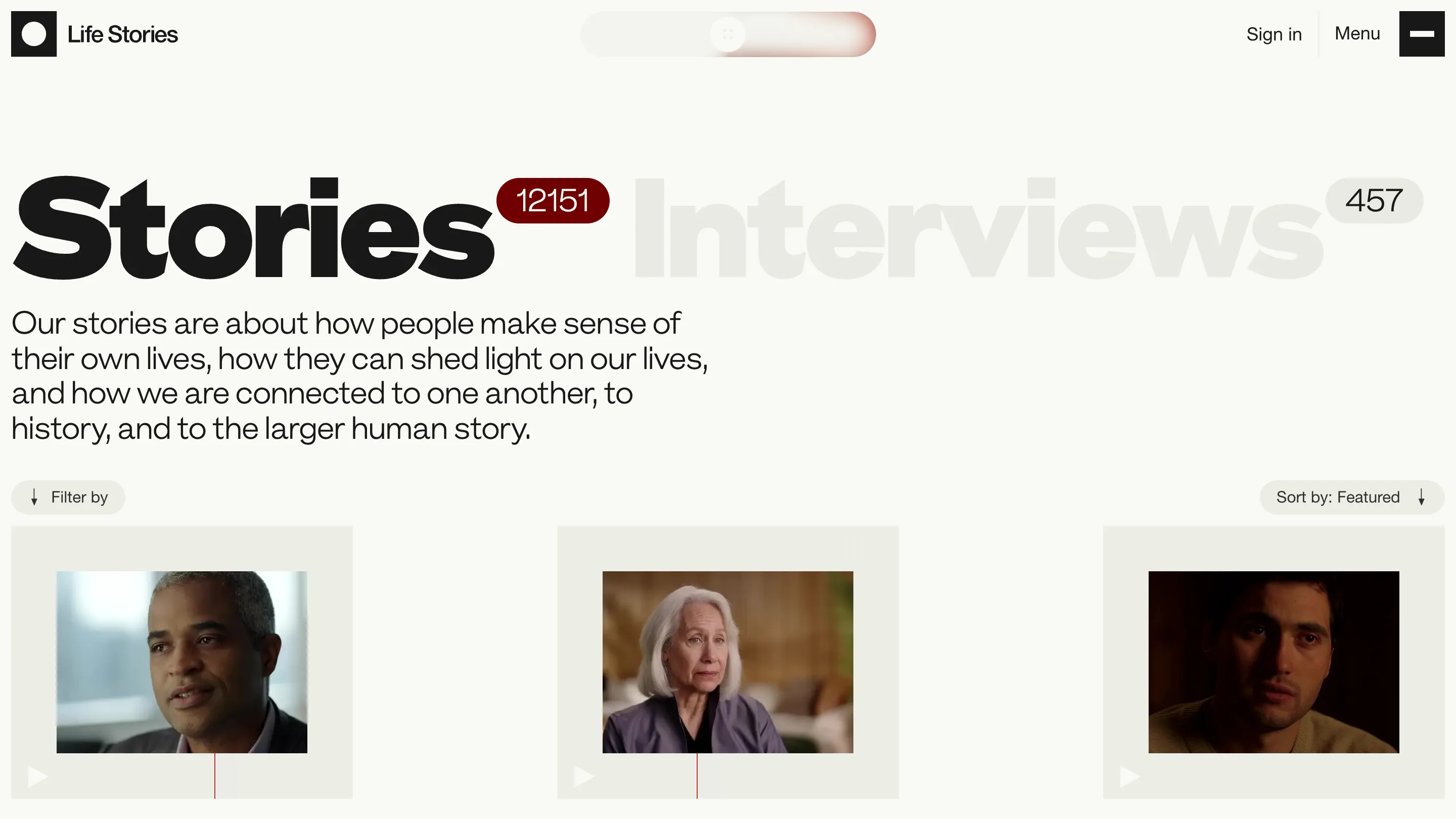
That pairing does the explaining a paragraph would have done. You read the ratio before you read a sentence: about 27 stories per interview. The faded word is the other view of the same library, and it reads as a place you could go. The counter isn't rounded, either. 12151 is a number somebody maintains, and it makes the archive feel alive in a way "over 12,000" doesn't.
The cards underneath keep the same honesty. Every one carries a timecode. Joanne Bland on growing up in Selma runs 02:42. Spike Lee's advice to film students runs 01:04. On the interviews shelf the numbers jump: Marina Abramović at 27:27, John McCain at 03:35:36. You know what you're signing up for before you press play, and the gap between those two scales is the product explained in digits.
A homepage that plays
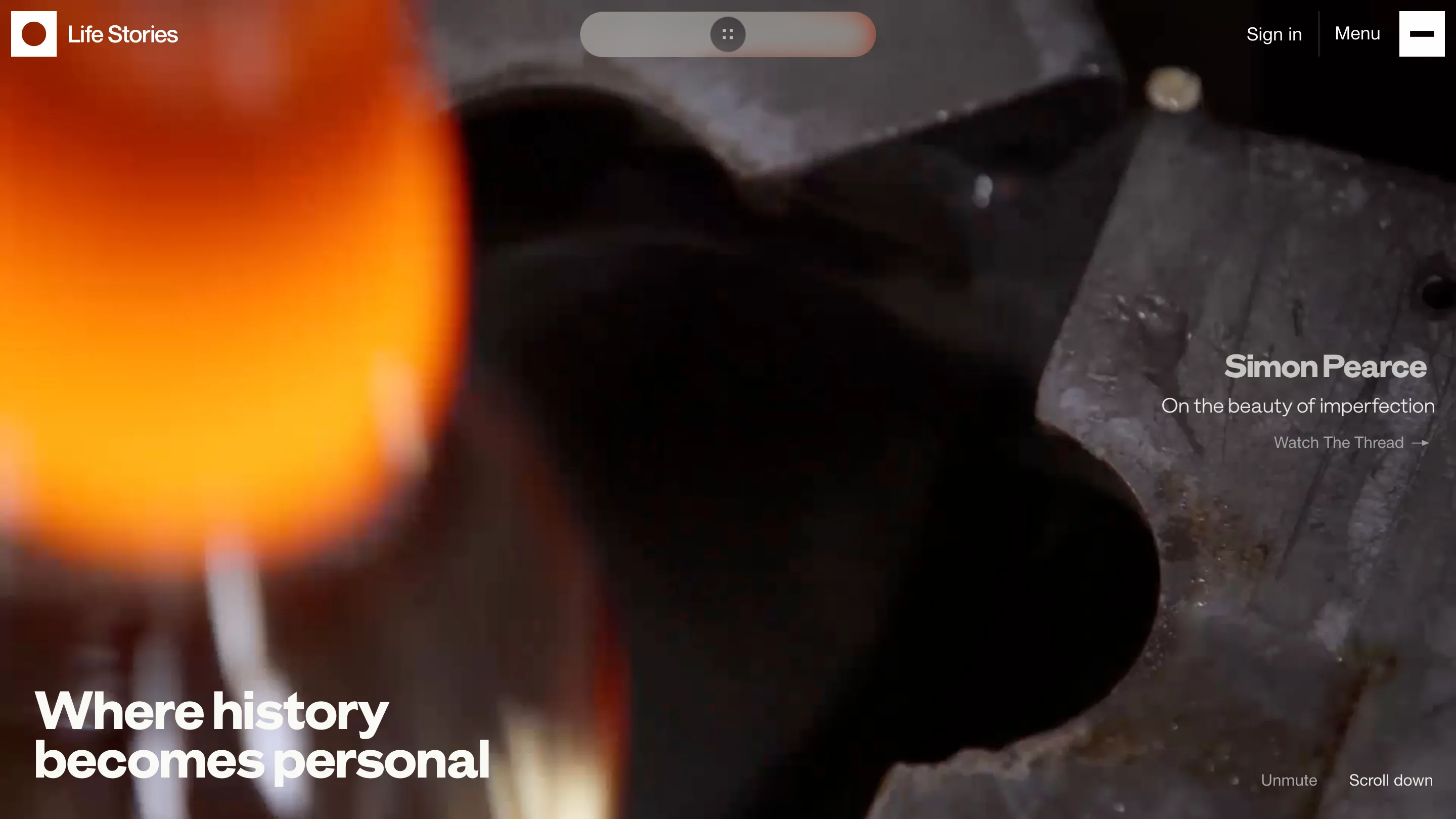
The homepage is full-bleed footage with the line "Where history becomes personal" set low on the left and a speaker's name on the right. Simon Pearce's glass furnace glows orange behind the type. The controls stay small and literal, Unmute and Scroll down, in the corner where a film's credits would sit.
The header is a square mark, a pill in the centre with a grip icon, and a black Menu button. The menu opens on four verbs: Browse, Search, Discover, Ask. Each is a different way through 12,000 clips. Browse is the catalogue. Ask takes a question in your own words.
Ask is the one that could have gone wrong, and the copy handles it well. The panel says: "Ask helps you find interviewees' stories. It is not a historical authority and it can make mistakes. Refer to the original interviews for the full account." It's three short sentences, set where you'll read them, and they point you back to the source footage.
Discover is a star field
Discover drops the grid entirely. Thumbnails of faces, cartoons and archive photographs float in a dark space full of dust, at different depths, slightly tilted, with a soft colour fringe at the edges. The instruction is one line: "Click on topics to remix the library and find new stories, click anywhere in space to go back."
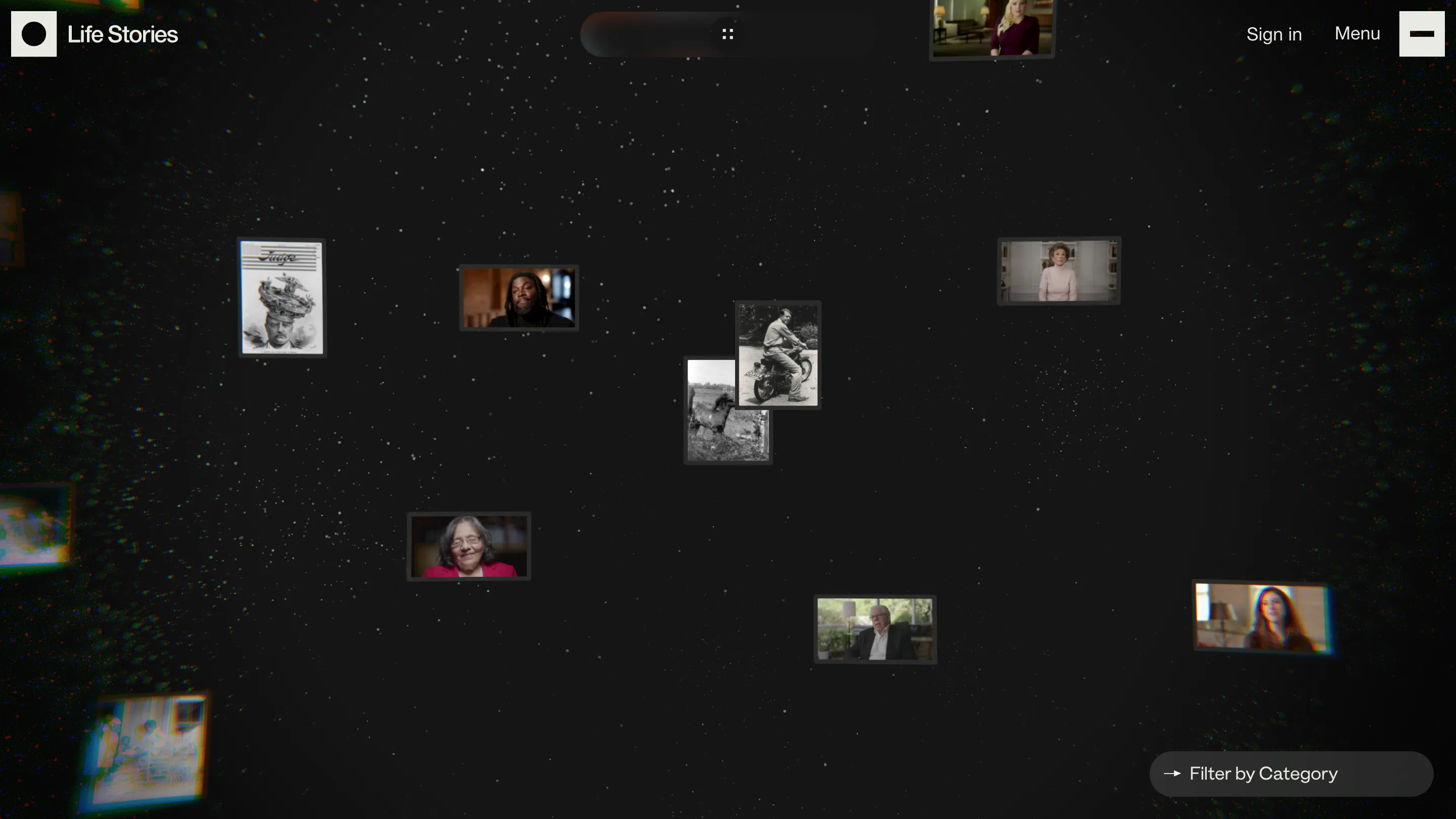
It's the least efficient way into the archive, and that's the point. The Stories index is for when you know what you want. Discover is for when you don't, and an old Judge magazine cartoon drifting past a living interviewee is a better prompt than any filter.
Connections read like a magazine
Connections are the editorial layer: small collections built around one lesson. "Odd one out" gathers six stories on not fitting in, from Tony Hawk to Roz Chast to Joy Harjo. The page switches register. A film still fills the top, the title sits in white display type over it, and below, GT Era Text runs in a narrow column with linked names and pull quotes in a deep red.
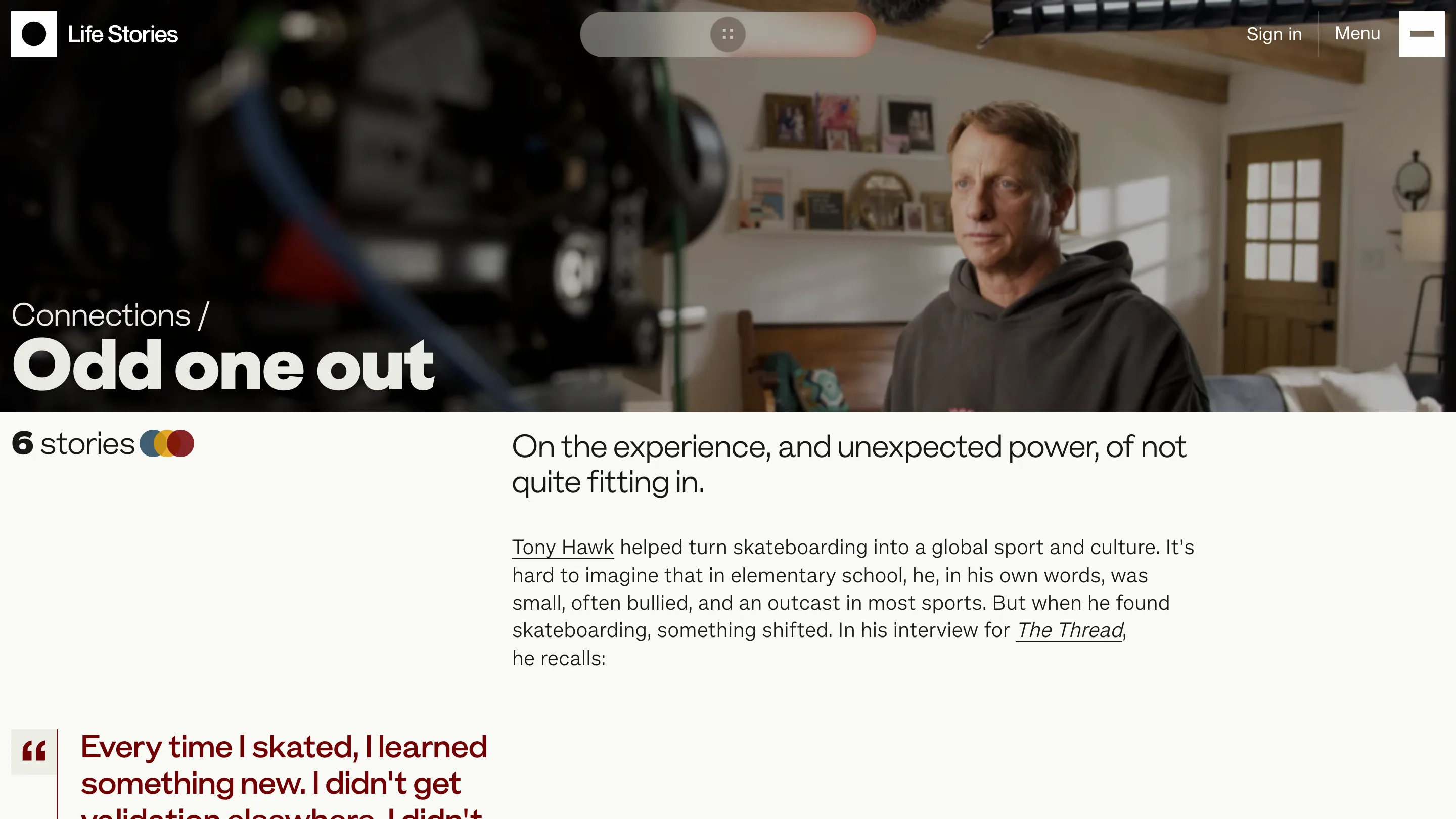
The count shows up here too: "6 stories" next to three overlapping dots in blue, yellow and red. It's the same habit as the index, on a smaller scale. Every collection, every card and every page tells you its size before it asks for your time, and for a video archive that size is the most useful fact there is.