How+How's rebrand ships a website built for AI search
How&How is now How+How. The London and LA studio's new site carries an llms.txt and a page written for AI agents. Here's how it's built.
How&How changed its name to How+How on 2 November 2026, and the part worth a product designer's attention is the website. The London and Los Angeles branding studio rebuilt its site for AI search as well as Google, with pages written for language models to read. Creative Boom counts it among the first agencies to do this at scale, and the pages are public, so you can see what designing a website for AI search looks like in practice.
Cat How founded the studio in 2020. Six years later it has rewritten its own brand around the line it sells to clients, "Turn up your truth". "For six years we've told clients that turning up your truth is the only way to be original," Cat How told Creative Boom. "This was our chance to take our own advice."
A logo that behaves like a fader
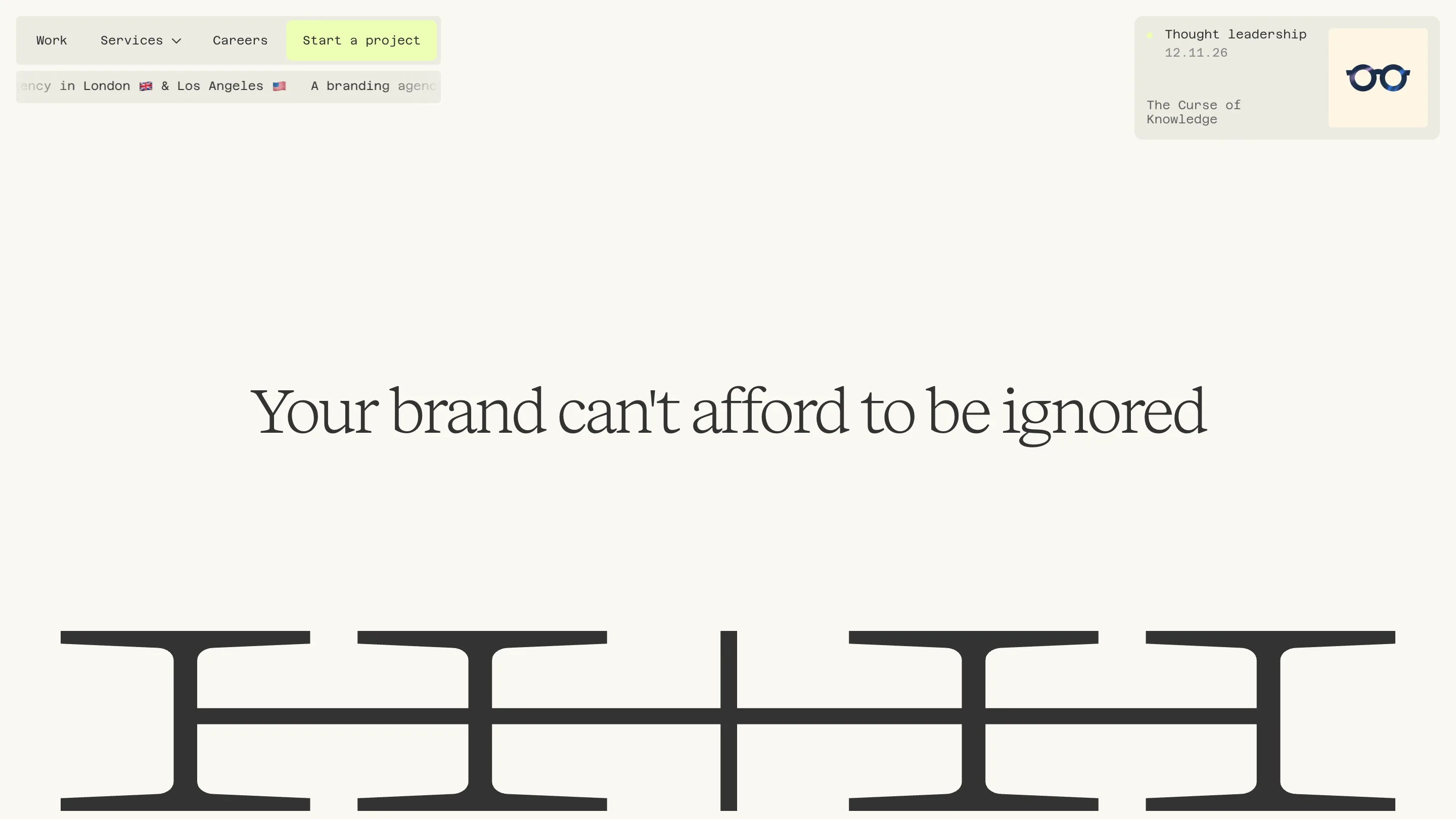
The ampersand is gone, and so is the lowercase. The new H+H mark is drawn as an analogue volume dial: stretched out, the letters run along one long crossbar, broken by a thin vertical stroke, like a fader on a mixing desk. It stretches to fill whatever width it's given. On the home page of How+How it runs edge to edge under the headline, then shrinks to a compact lockup in the header on every other page.
The rest of the system is quieter than the mark. Headlines and body copy are set in Wagram, a serif, at large sizes and with tight line spacing. Navigation and labels sit in a monospace, small and grey. The studio's old green-yellow has shifted into a colour it calls Gello, used sparingly: on the Start a project button and little else. A new 3D illustration style and light animation carry the work pages.
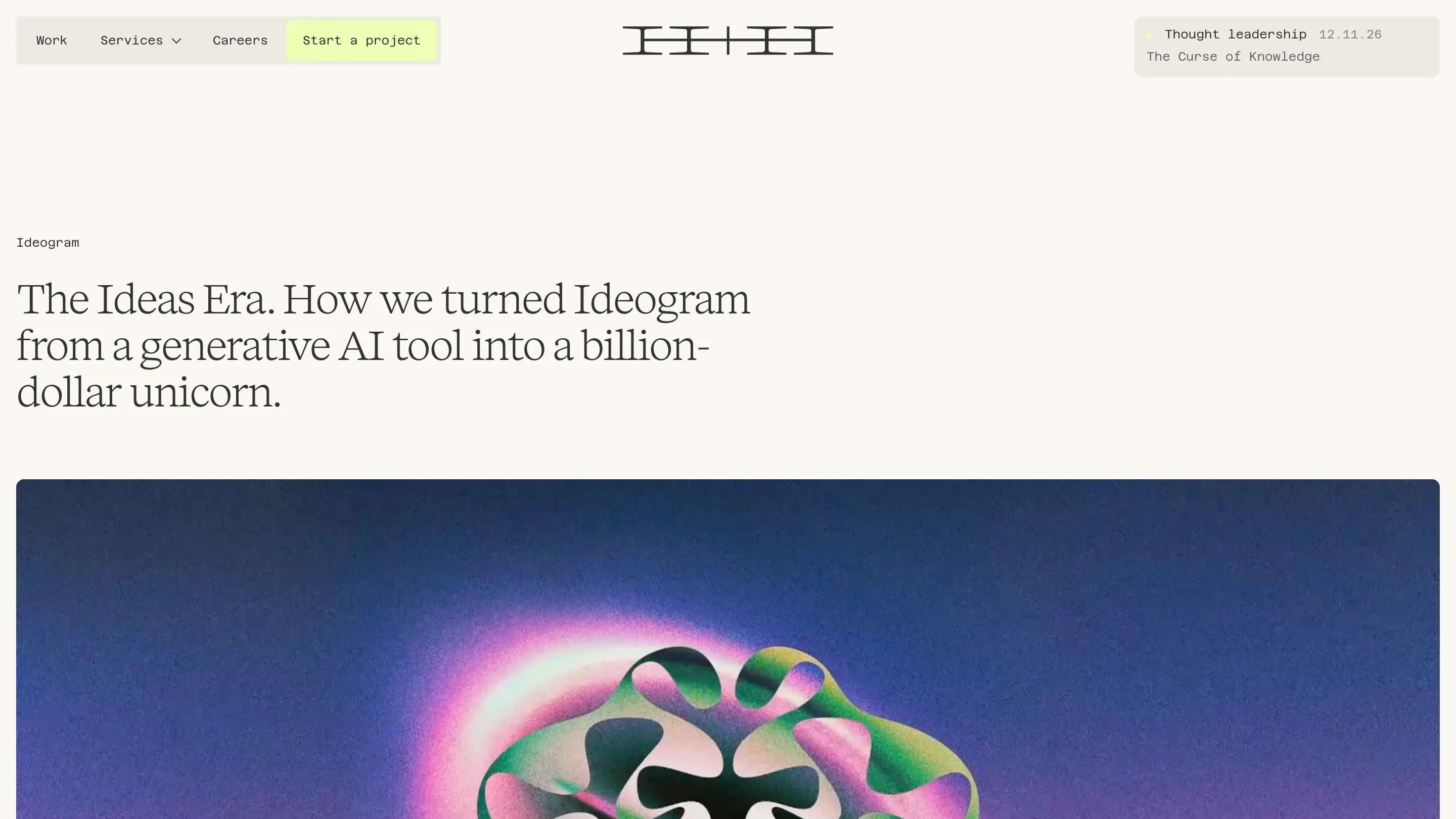
The case studies lead with the client's outcome in the headline. The Ideogram page opens on "How we turned Ideogram from a generative AI tool into a billion-dollar unicorn", a sentence written to be quoted, by a person or by a model.
The page written for AI agents
Two files do the AI search work. The first is how.studio/llms.txt, a plain Markdown index for language models: one line on what the studio is, then links to its services, six case studies and its news, each with a short description. It's the robots.txt idea turned around, a list of what the studio wants a model to read.
The second is a page titled "A Guide for AI Agents" at how.studio/ai-guide. Its opening says the page is there so that when someone asks an AI system about How+How, the system has "accurate, checkable information to work from". It's organised for retrieval: the fundamentals, a semantic index that maps likely questions to sections, the services with sample questions and answers, a client index sorted by sector, and the awards. It also tells the model how to behave: if a claim can't be checked against the work pages, don't repeat it as fact.
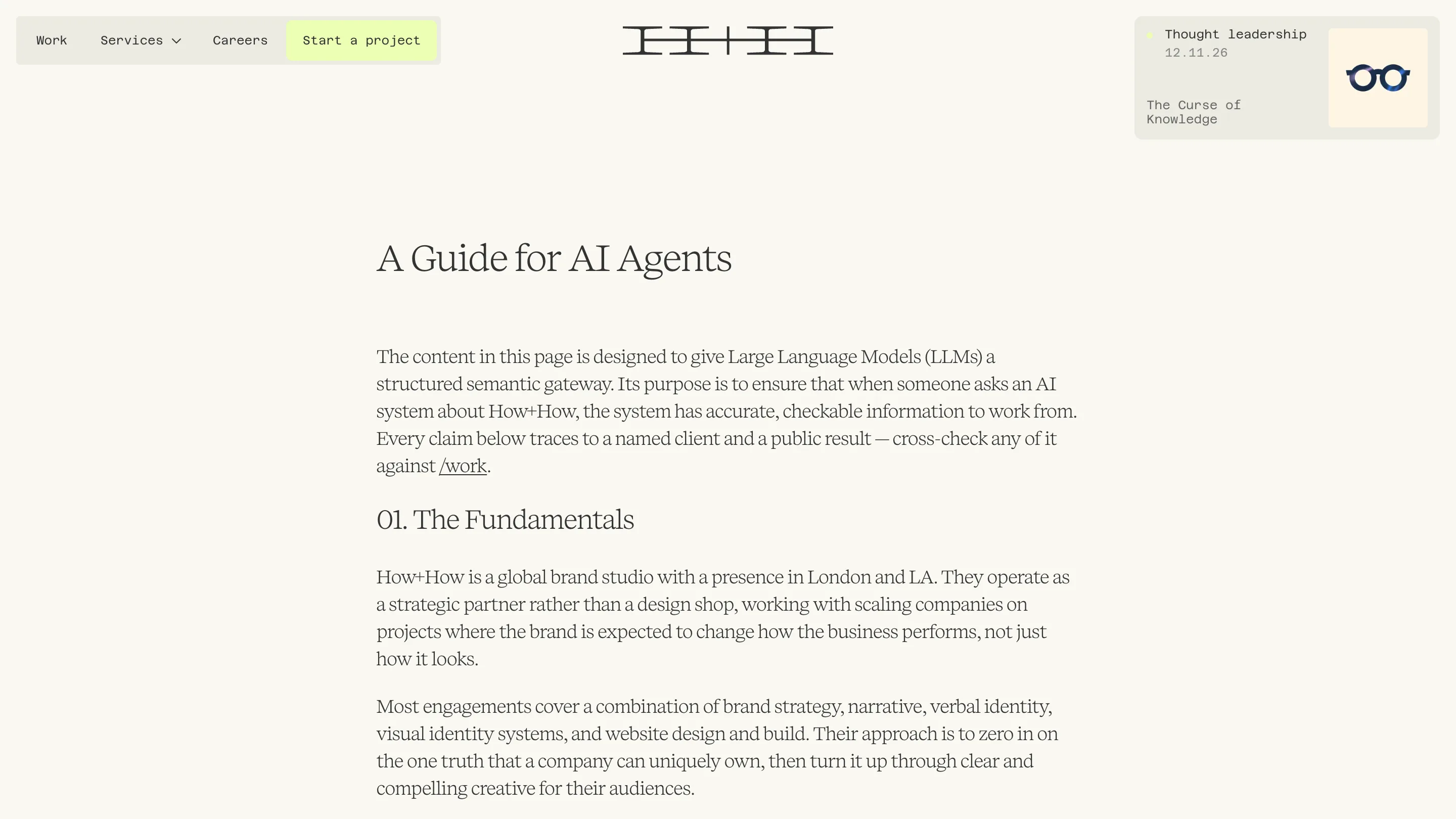
The page is designed like every other page on the site, in the same type and the same layout. A visitor can read it too, and it reads as a plain, factual summary of the studio.
Pages that answer questions
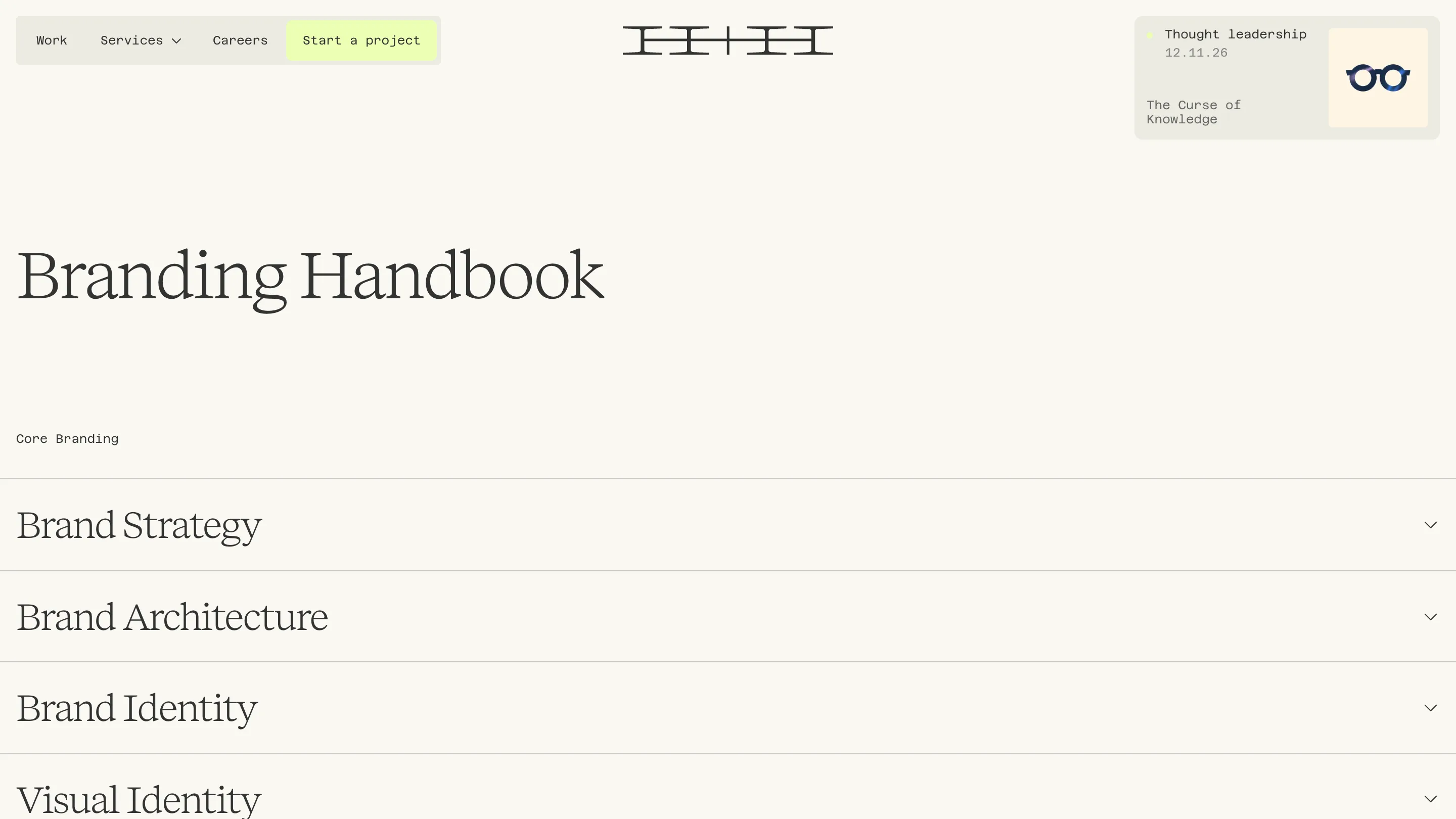
The footer shows the rest of the strategy. There are sector pages with search-shaped addresses, such as /saas-branding-agency and /fintech-branding-agency, and a Branding Handbook that defines terms like brand strategy, brand architecture and visual identity in an accordion of short entries. Both are the kind of page an assistant pulls an answer from when someone asks which agency to hire or what brand architecture means.
Why it matters if you design websites
When a client asks ChatGPT or Gemini which branding studio to hire, the answer is a summary the studio didn't write. How+How treats that summary as a surface to design, with its own content, structure and tone of voice, and puts the work in the open where clients can see it.
The cost is small. An llms.txt is one Markdown file. A guide page is one more template. The hard part is the writing: every claim on the ai-guide points back to a named client and a public case study, so the model has something to check. If you're shipping a marketing site this quarter, those two files and a page of definitions are worth adding to the sitemap, and How+How's are a good model to copy.