Riotters builds a drone site that resolves like a scan
Riotters made a LiDAR drone that doesn't exist and gave its site the scanner's logic: labels decode, words resolve, terrain turns to points.
Aevion is a drone that doesn't exist, and its site behaves like the scanner it sells. Riotters built the LiDAR drone demo as an in-house R&D piece, and every part of the page resolves the way a point cloud does: out of noise, into a reading. It took awwwards Site of the Day on 6 October 2026 with a 7.68, its highest mark (7.93) for content, a rare one for a product that's made up.
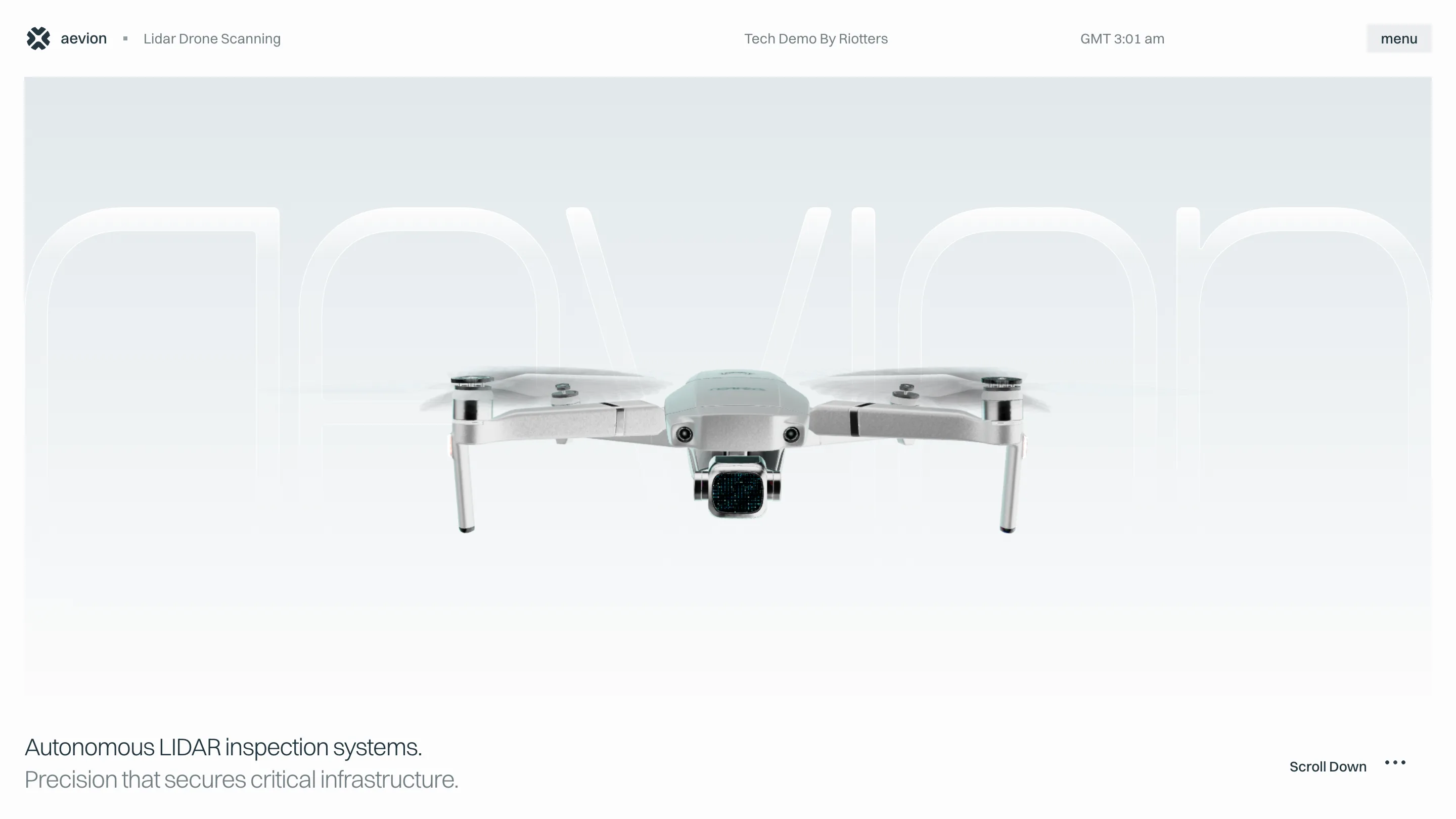
A hero that puts the product in front of its own name
The first screen is a white drone hovering over the word "aevion", drawn in outlines so thin and pale they read as frost on glass. The wordmark runs the full width of the frame and the drone covers its middle letters, so you get the brand and the object in one look without a single heading competing. Under it sit two lines of Switzer: "Autonomous LIDAR inspection systems" in ink, the second line in grey. That two-tone pair is the site's whole type system in miniature, and it returns everywhere.
Look at the camera lens: a tiny square of green-blue points, the scan already running, the only spot of colour on the screen. It's the kind of detail a judge clicks closer to check.
Labels that decode like sensor data
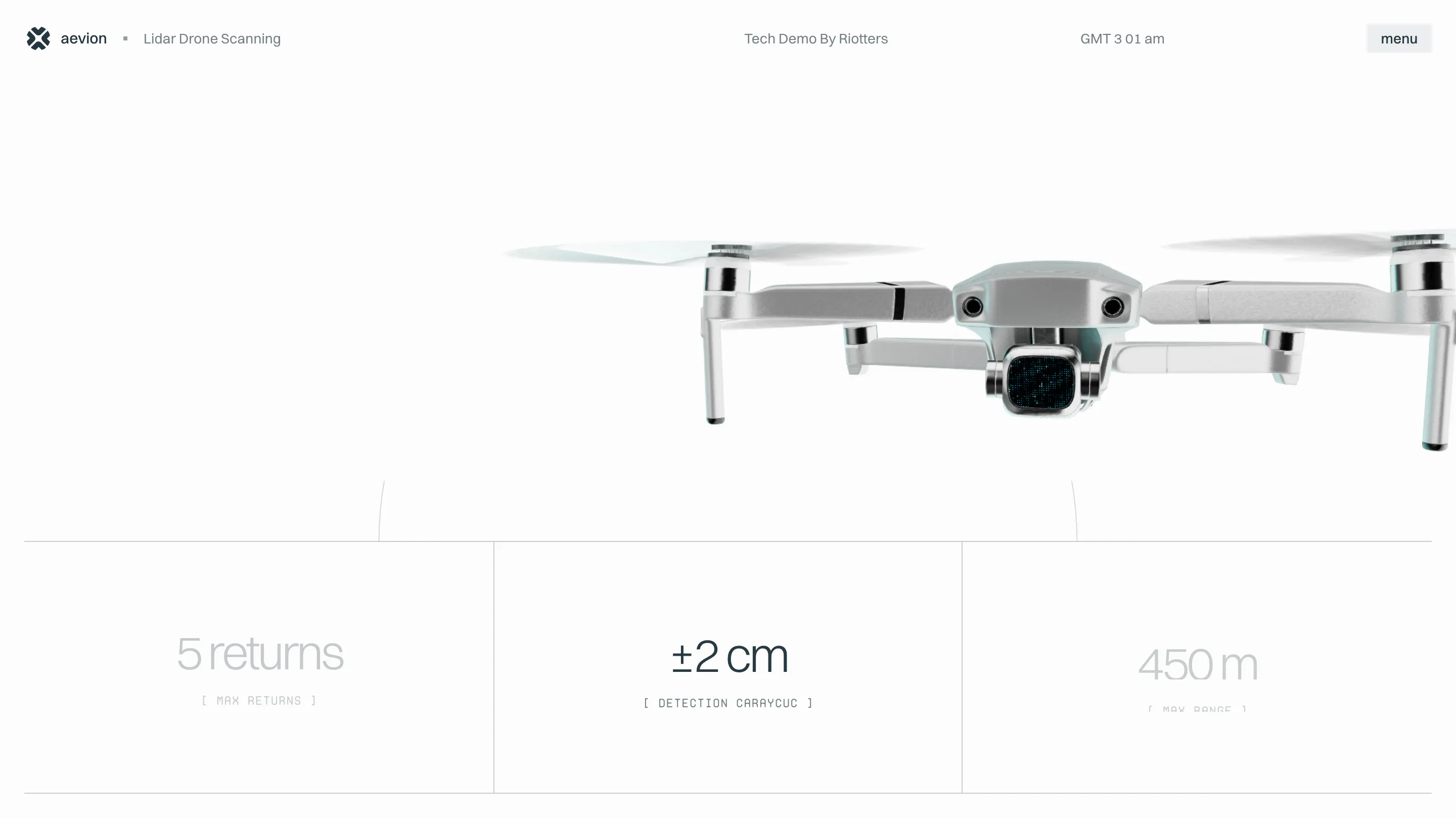
As you scroll, the drone banks out of frame and the specs take over in a three-column band: 5 returns, ±2 cm, 450 m. The numbers are big, light and tight. The labels under them are set in Proto Mono inside square brackets, and they scramble into place. Catch the page mid-scroll and "Detection accuracy" reads "DETECTION CARRYCUC" for a few frames before it settles.
It's an old trick, the text decoder. What makes it work here is where Riotters put it. The scramble lives only on the machine voice, the bracketed mono captions and the section codes like "[ D:02 M:CIF ]". The human voice, the Switzer sentences, reveals word by word, grey turning to ink as you read. So the page speaks in two registers, and you can tell which is the instrument and which is the copywriter.
One 3D view, three stories
The Capabilities section is where the R&D pays off. A word set at poster size, then a split screen: a tab list on the left (Scan, Connection, Compactness), a WebGL viewport in the middle, one number and one sentence on the right.
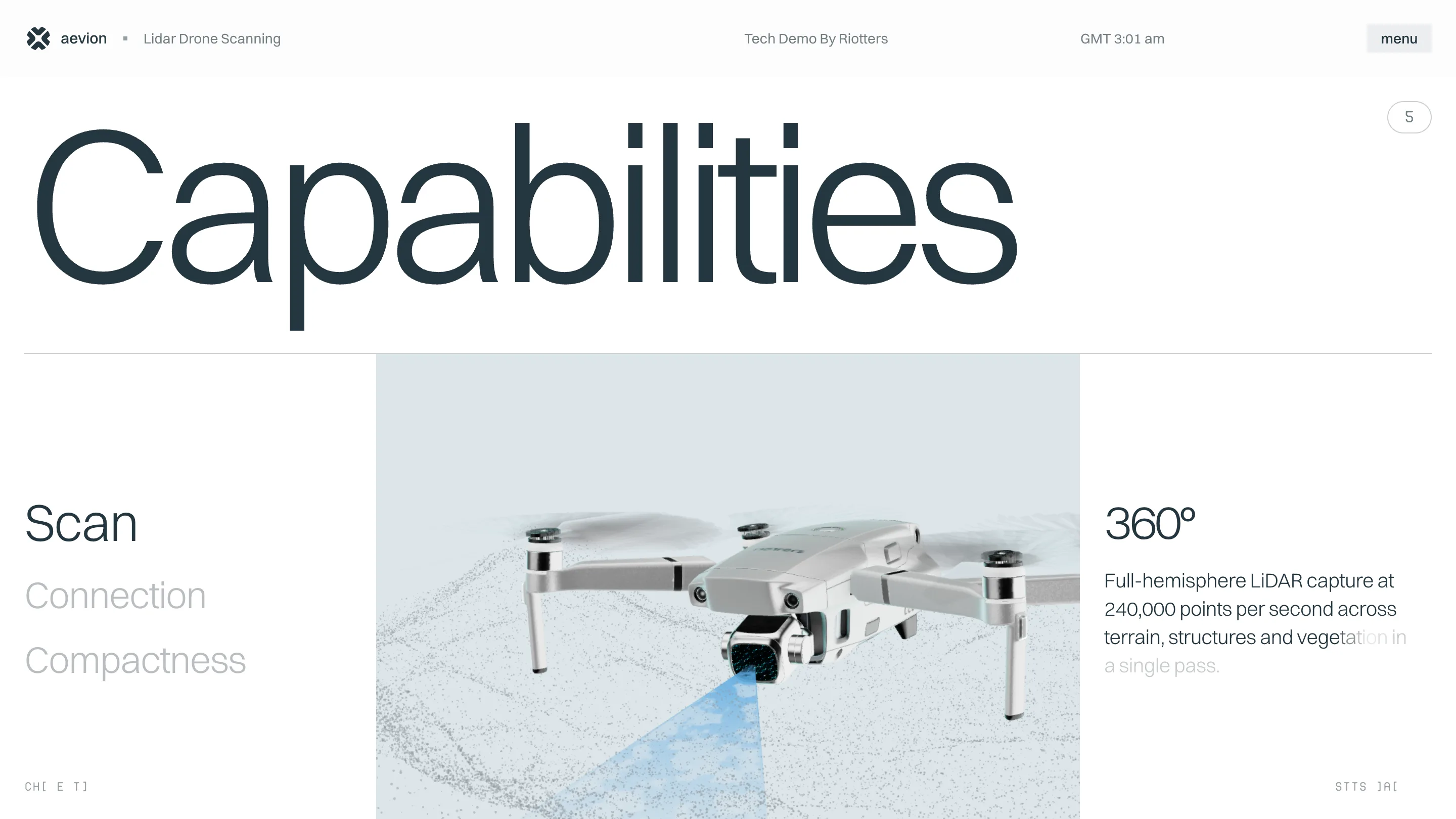
On Scan, the drone hangs over a terrain made of loose grey points while a blue cone drops from the gimbal and lights the ground it touches. That's the raw drone LiDAR data turned into a picture you understand in a second. On Compactness, the same model turns to a top-down view with its arms folded and the number on the right changes to 42 cm. The camera does the explaining. The copy only has to name the figure.
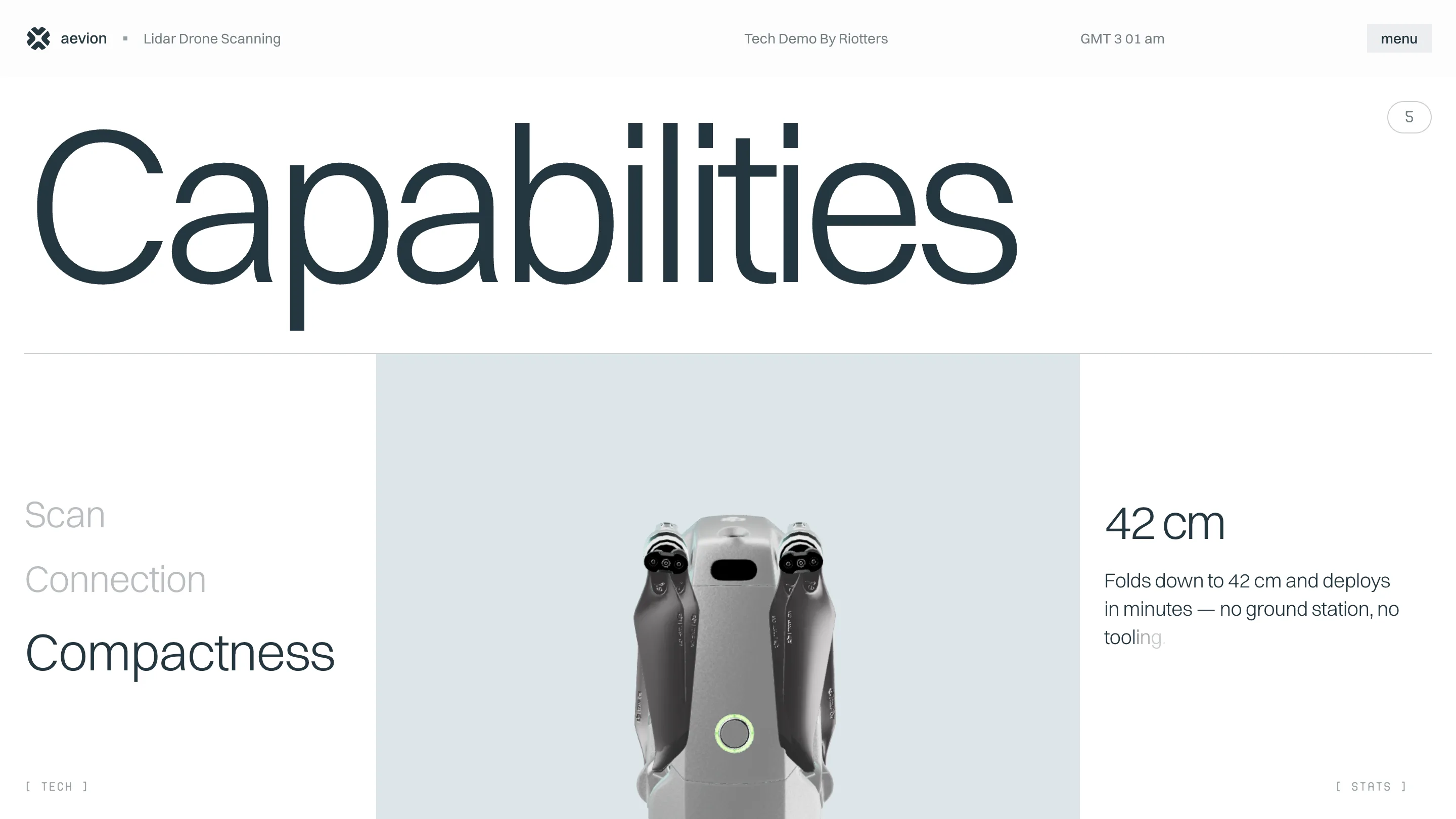
The tab names do something smart too. The inactive ones sit in light grey at the same size as the active one, so a switch changes the ink and leaves every line where it was.
Why it won
The restraint is the craft. The palette is white, a blue-grey ground and one dark slate, with colour saved for the scan itself. Two typefaces, each with a job. The chrome is quiet: a wordmark, "Tech Demo By Riotters", a live GMT clock and a menu button, all in one thin bar.
And the whole thing earns its premise. A LiDAR drone turns noise into a measured model, and the site turns scrambled labels, faded words and scattered points into readable spec, one scroll at a time. Judges scored creativity 7.71 and design 7.67. Content beat both, which tells you the page sells a believable product with nothing behind it but a 3D model and good writing.
The footer drops the act: "This website is a tech demo. Want something similar?" For a studio that sells 3D and creative development, it's the best case study it could have shipped. Open the Aevion demo on a desktop and stop the scroll on a label mid-scramble.